Big News: COPA Has Passed

Community Opportunity to Purchase Act (COPA) has been passed by City Council and awaits signing by Mayor Eric Adams.

Every property owner needs to understand what this means because it will radically change the way property sales will transpire for affected properties (if this is your first time hearing of it, review my article here, breaking it down). This is highly relevant for merchant builders who leverage city tax abatements to build their properties and rely on asset sales to fund their future projects. The silver lining, as I emphasized in a previous write-up here, is that most properties are exempt. Specifically, multifamily properties that don’t have immediately hazardous violations, city-documented property distress, or specific regulatory agreements with HPD or city agencies, are exempt.
Digging a little deeper beyond just the basics, below are three things to know about the new bill:
HPD has not clarified whether 421-a, 485-x, or 467-m buildings will be subject to COPA. The investor uncertainties right now are mostly focused around whether 421-a is exempt. My hunch is that some 421-a properties will be exempt and some will not. My thinking follows a common-sense approach and is as follows:
421-a (1-15) properties, or apartment buildings that were delivered prior to 2019, will be exempt. This, on the basis that these properties are not typically encumbered by affordability requirements.
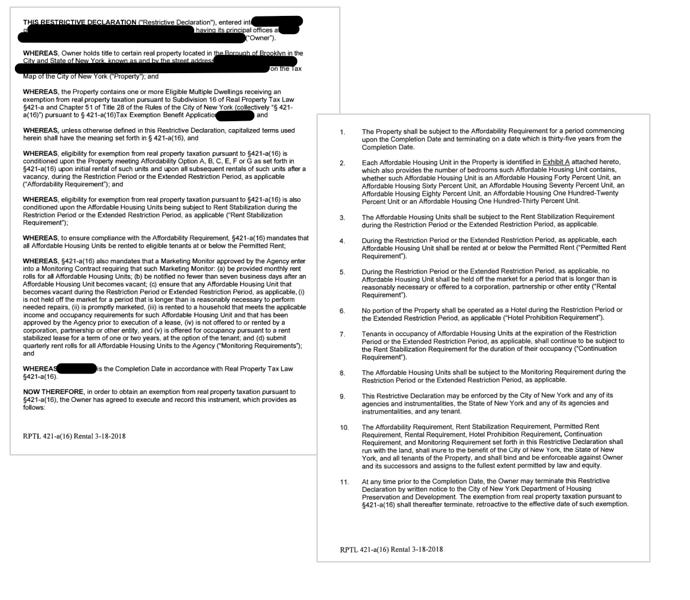
421-a (16), also known as Affordable Housing New York (AHNY) will be subject to the COPA regulations. These properties have recorded agreements in place with the Office of the City Register, stipulating the income restricted nature of some of their units, the area median income (AMI) ceiling for those units, and the duration of the abatements. See examples below.
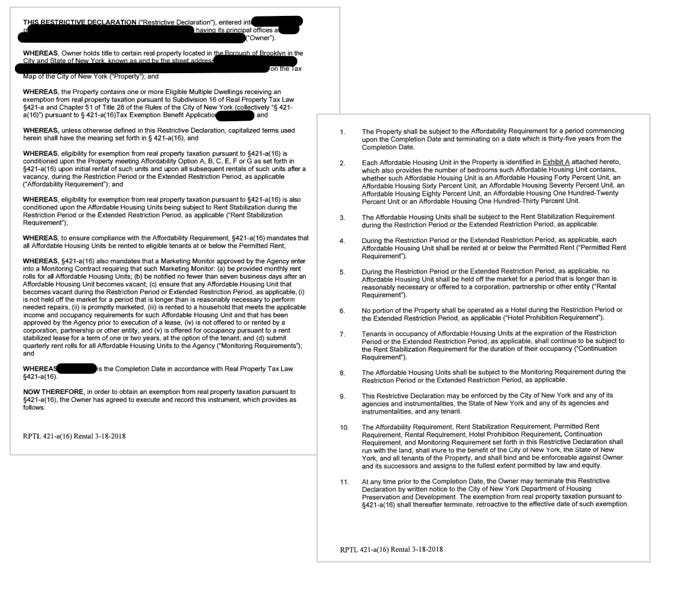
Note: See above an example of a restrictive declaration for a project in Brooklyn leveraging the 421-a (16) tax abatement. It is Sinclair Realty Group’s view that this would be subject to COPA. It is our view that 485-x and 467-m projects will also be subject to COPA.
Passed with 31 City Council votes in the affirmative (about 61% of the City Council), the law is not technically veto-proof, so Mayor Adams could, in theory, veto the bill in the next 10 days of 2025 and void it.
Timelines have also been compressed. The bill, prior to its amended form on December 12, would have required owners of covered properties to hold court and engage with non-profit buyers for a minimum of 145 days if non-profits submitted initial and then later-stage interest. Now, the timeline is down to 120 days. If non-profit buyers express no interest, the process could be over in only 25 days. See updated graphic on timeline below.
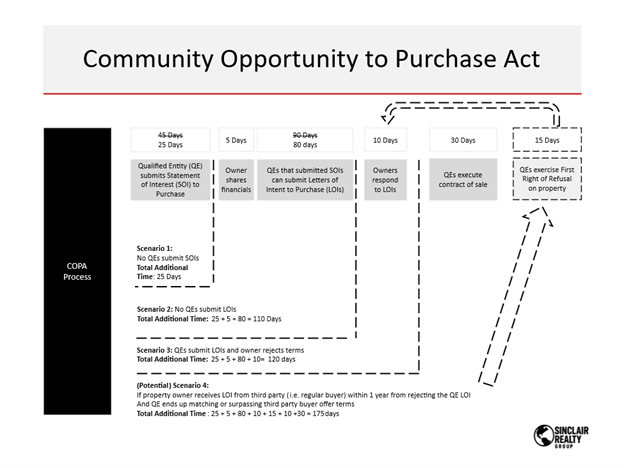
Source: City Council Minutes (page 24)

I am bullish on NYC multifamily.
Best Regards,
Romain Sinclair
646 326 2220
COPA? Omg! That’s what NYC needs! More people who can’t afford to live there. Typical politicians!